Does Life Coaching Actually Work? And How to Choose the Right Coach for You
One of the first things women say to me is, “I’ve never reached out to a life coach before.” They often arrive a little frazzled. Sometimes it’s a call from the CRA. Sometimes it’s a hard week at work. Sometimes nothing dramatic at all.
Life coaching is a structured, forward-focused conversation designed to help you create intentional change.
Many of them tell me, “Life is good. But I deserve better.” Or, “I feel stuck, but it’s not that bad.” Or, “I should probably be able to handle this myself.” Often, they are the one others lean on. Stoic. Reliable. Women reach out to me because they crave a safe space where they can be vulnerable, and supported.
Sometimes they can name it clearly. They want to feel lighter. More alive. More confident. Less reactive. They want to wake up and feel excited about their own life again. They want to feel the fear and do it anyway.
Other times, they can’t quite articulate it yet. They just know they don’t want to keep circling the same thoughts. They want to say yes to themselves without that fear-and-doubt voice jumping in with, “What have I done?”
If you are wondering how to choose a life coach or asking yourself does life coaching actually work, read on. That’s what this article is here to answer.

What Life Coaching Is — And What It Isn’t
Life coaching isn’t about fixing a broken life. It’s about helping you examine the parts that no longer fit and decide, deliberately, what comes next.
Life coaching is a structured, confidential conversation focused on you. We slow things down. We untangle what’s actually going on beneath the surface. We look at patterns, beliefs, and the way you’re relating to your work, your relationships, and yourself.
It’s collaborative. I’m not there to tell you what to do. I’m there to ask questions that help you hear yourself more clearly.
It’s also not endless venting. There is structure. There are milestones. There is accountability. If we decide to work together, we define what you’re working toward and we move toward it intentionally.
Life coaching is future-oriented. We don’t ignore your past, but we don’t live there. We look at where you are now and what you want your life to feel like moving forward.
It’s practical. It’s reflective. It’s sometimes uncomfortable in the way growth often is. And it’s deeply personal.
What it isn’t is therapy. Coaching does not diagnose or treat mental health conditions. Sometimes women benefit from both therapy and coaching, and that can be a powerful combination.
It also isn’t motivational cheerleading. I’m not nodding and saying, “Yes, everything’s terrible,” and I’m not giving you affirmations to paper over what’s real. We look at what’s true. We take responsibility for what’s yours. And we build from there.
And perhaps most importantly, coaching isn’t something that’s done to you. It’s something we co-create.
As I often tell women on a first call, “We’re here to explore what’s going on. If it feels like a fit to help, then we talk about next steps.”
It’s a space where you get to be honest, where you can admit that something feels off, where you don’t have to justify why you booked the call.
That’s what life coaching is.
Life Coaching vs Therapy — Understanding the Difference
“How is life coaching different from therapy?” This is one of the most common questions I’m asked.
According to the American Psychological Association, psychotherapy is a treatment process that helps people identify and change troubling emotions, thoughts, and behaviors, and is often used in the diagnosis and treatment of mental health conditions.
Therapy is essential work. If someone needs clinical mental health support, that’s outside the scope of coaching. Coaching is not about diagnosis, treating mental illness, or processing trauma in a clinical sense.
Coaching is future-focused. It’s about clarity, identity shifts, transitions, and decisions. It’s about asking: Where am I now? What feels off? What do I want instead? And how do I move toward that intentionally?
Women often come to coaching when nothing is technically “wrong,” but something doesn’t quite fit anymore.
In coaching, we work with your mindset, your nervous system, your patterns, and your choices. We build self-trust. We create plans. We stretch comfort zones gradually and deliberately.
Coaching does not replace therapy. If someone is experiencing significant depression, unresolved trauma, or other clinical concerns, therapy is the appropriate and necessary support. Sometimes women are working with a therapist and a coach at the same time, and that can be a powerful combination. Therapy may focus on healing the past; coaching may focus on building what comes next. Part of the first conversation is simply exploring whether coaching is the right fit for where you are.
Does Life Coaching Actually Work?
Short answer: Yes, life coaching works.
Longer answer: How much life coaching works depends on how you show up.
I provide life coaching in Kamloops, across the BC Interior, and throughout Canada online. Some clients came in the middle of divorce. Some were navigating grief. Some were burned out leaders. The common thread is readiness.
When Coaching Works Well
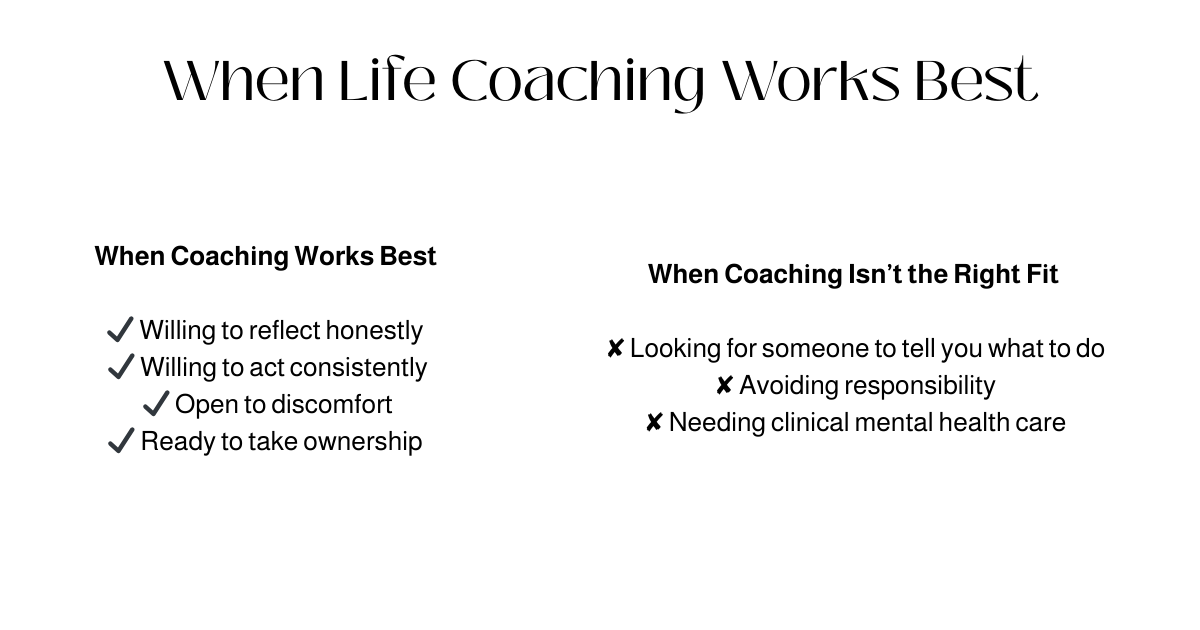
Coaching works beautifully when you are willing to reflect, ask yourself more questions and work at making subtle weekly shifts. You have to do the work and make bite-sized shifts that compound over time.
Life coaching is uncomfortable at times, so it works when you choose the discomfort of change over the discomfort of staying stuck. You don’t necessarily need to know what you want to change, but you know you want life to be different.
Coaching works when you take ownership. It’s not advice-giving. It’s not me telling you what to do. One of the things my clients consistently say is that they feel heard, empowered, and equipped, without me imposing my own values.
The power comes from you thinking about what’s going on and what you want, making the decision to take a stand for you, and taking one step at a time to change your reality. I see it play out every week with my life coaching clients.
Women who felt overwhelmed now talk about feeling lighter, clearer, and more intentional.
Women who once described themselves as stuck now say they are more confident and focused on the future.
When Coaching Doesn’t Work
Coaching doesn’t work well if you want someone to tell you exactly what to do. That’s abdicating responsibility, which is the opposite of the work we do together.
If every obstacle is someone else’s fault and you’re looking for a step-by-step prescription for your life, you’re in the wrong place. Coaching asks questions. It reflects patterns. It challenges gently. It requires you to examine yourself closely.
Life coaching alone is not appropriate if you need clinical mental health treatment. If you are experiencing severe depression, trauma symptoms, or other mental health conditions requiring diagnosis and treatment, you should speak to your doctor and explore therapy. Coaching can complement therapy, but it does not replace it.
“The more you put into it,
the more you get out of it.”
Coaching works when you participate. One client put it simply: “The more you put into it, the more you get out of it.” That’s the nuance.
Does life coaching work? Yes, when you are ready to look honestly at your life, take small intentional steps, and let someone sit across from you asking the questions you’ve been quietly avoiding. And if you’re somewhere in the BC Interior or anywhere else in Canada wondering whether this applies to you, that curiosity itself is usually the first sign that you’re ready.
What a Life Coaching Session Actually Looks Like
Your 50-minute online life coaching session with me is carefully structured while also feeling like a natural conversation.

We start by arriving with breathwork. That’s not a gimmick. It’s a nervous system reset. It helps you drop out of the day, soften your body, and actually be present for what matters. When your system is calmer, you think more clearly, and you can hear yourself.
Then we begin with celebration. A lot of women are so used to pushing through that they barely register what’s working. Celebrations help you build evidence. They remind your brain, “I’m capable. I’m moving. I can do hard things.” Even tiny wins matter, because they change how you relate to yourself.
From there, we move into what’s really going on. Sometimes you come in knowing exactly what you want to talk about. Other times you don’t. That’s normal. A good session doesn’t require you to show up with a perfect agenda. As a certified life coach, my job is to listen for what’s underneath the obvious, and to help you name the next layer.
That’s where pattern recognition comes in. We slow down and look at the story you’re telling yourself, the fear underneath it, and what’s actually true. Often it’s not the thing on the surface. It’s what the thing represents. Belonging. Safety. Being judged. Being alone. Not wanting to be a burden.
We also work with emotional regulation. Not by pretending you shouldn’t feel what you feel, but by building your capacity to stay with intense emotions without spiraling. When you can recognize that fear is normal, you stop making it mean you’re doing something wrong. Then we find a steadier, more helpful thought, and you practice replacing the old narrative. This is where my background and experience as a life coach in Kamloops comes in.
I bring real-world structure and strategy from leadership and project management, and I blend that with intuitive and somatic tools. It’s both practical and embodied. We’re not just talking about change. We’re building a plan that fits your real life, and we’re supporting your nervous system as you live it.
Then we finish with next steps and accountability. That usually looks like a small set of specific actions, not a long list. Something you can actually follow through on. Sometimes it’s mindset work. Sometimes it’s a practical task. Sometimes it’s a stretch that builds a new muscle.
That’s what sessions look like. Calm, structured, and real. A place where you can tell the truth, build evidence, and take the next right step.
What Kind of Problems Life Coaching Can Help With
Most women don’t come to coaching because they have one neat, tidy “problem.” They come because something is rubbing the wrong way inside their life, and they’re tired of talking themselves out of paying attention to it. If you’ve read this far the chances are you’re ready for a conversation about how online life coaching can help you stop circling the same problems and repeating the same patterns.
Divorce and Relationship Transitions
This isn’t just about navigating a breakup. It’s about rebuilding who you are when the old version of you was shaped by a relationship, a role, or years of adapting.
Coaching can help you steady yourself through change, and rebuild self-worth so you stop negotiating your needs down to something you can tolerate. Women often leave this work feeling clearer, more grounded, and more confident making decisions that actually match their values.
Career and Purpose Shifts
Sometimes your career is “fine,” but you can feel you’re outgrowing how you’ve been operating, what you’ve been saying yes to, or what you’ve been settling for. Other times it’s a clear shift, a new direction, a new identity, or a decision you keep postponing.
Coaching supports you to get honest about what you want, redefine what success means for you now, and build the confidence to move without burning your life down to do it. This is where the practical strategy and the deeper identity work meet.
Burnout and Overextension
A lot of capable women are functioning… but stretched thin. They’re managing, performing, and coping, while quietly feeling reactive, tired, and resentful that they’re always the strong one.
Coaching helps you build capacity, create sustainable boundaries, and change the internal pattern that keeps you over-giving. The outcome isn’t just “less stress.” It’s more clarity, more steadiness, and a life that feels manageable and yours again.
Identity After Children Leave Home
When your role shifts, even slightly, it can bring up a bigger question: who am I when I’m not needed in the same way?
Coaching supports you to reconnect with your own desires, build a sense of direction, and create a life that doesn’t revolve around waiting for the next thing to happen. Women often describe this as rediscovering themselves, not as a dramatic reinvention, but as coming back to what matters.
Feeling Stuck in a “Good Life”
This is one of the most common reasons women reach out in the BC Interior and beyond. Life works. Nothing is technically wrong. And yet there’s a quiet sense of, “I can’t do another year like this.”
Coaching helps you name what’s no longer fitting, trust what you’re sensing, and turn subtle dissatisfaction into deliberate change. Often the biggest shift is learning to trust your inner compass again, and having a grounded plan to follow through.
If you’re not sure your situation “counts,” that’s often a sign you’ve been minimizing yourself for a long time. Coaching is a place where you get to take your own life seriously and make yourself a priority.
Common Misconceptions About Life Coaching
There’s a lot of noise online about life coaching. Some of it is fair curiosity. Some of it is skepticism. Some of it is based on experiences that weren’t well handled. Let’s walk through a few common questions.
“Isn’t it just motivation?”
No. Motivation is a feeling. It rises and falls. Coaching is a structured process.
In a session, we look at patterns, decisions, identity, and behavior. We build awareness, create practical next steps, and strengthen your capacity to follow through. Yes, you may feel encouraged. But the work is not hype. It’s reflection, strategy, and integration over time.
“Isn’t it therapy?”
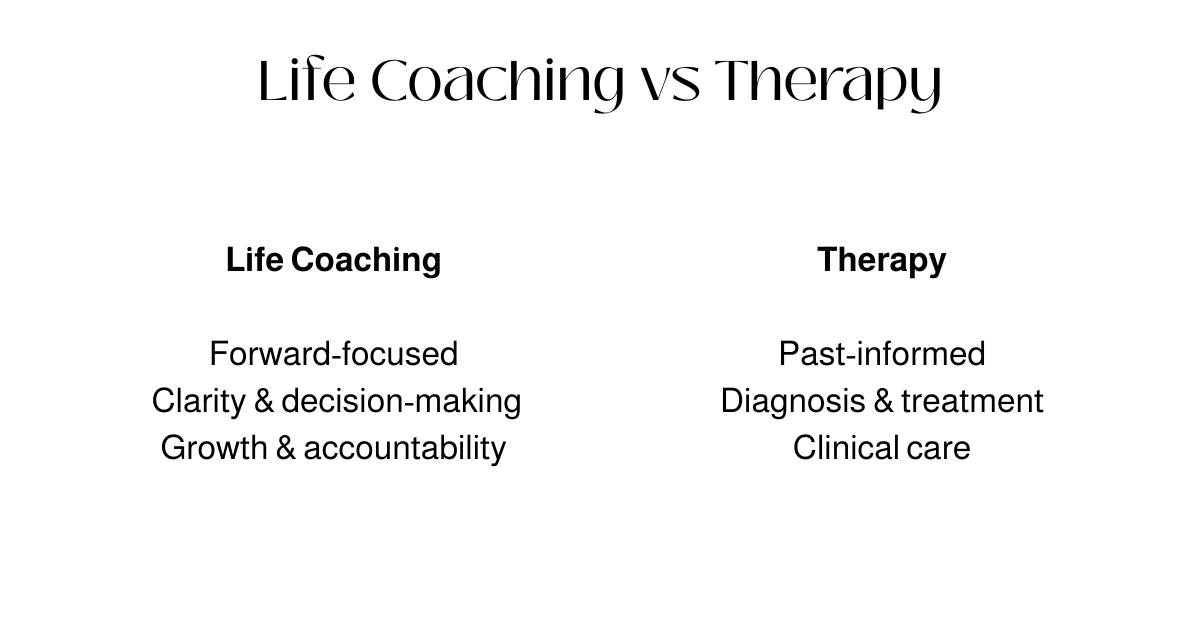
They overlap in that both involve talking and reflection, but they serve different purposes.
Therapy focuses on diagnosing and treating mental health conditions, processing trauma, and working through clinical concerns. Coaching focuses on clarity, transitions, identity shifts, and forward movement.
“Isn’t it only for people in crisis?”
Most of the women I work with are not in crisis. They often have a “good life” on paper. Career is fine. Kids are fine. Finances are stable. But something feels off. They feel stuck, restless, or underutilized.
Coaching is often about subtle dissatisfaction becoming deliberate change. It’s about wanting more alignment, not emergency intervention.
“Does online coaching really work?”
Yes, when the structure is clear and the engagement is real.
The medium doesn’t reduce the depth. If anything, meeting with an online life coach can make it easier to integrate coaching into real life because you’re applying insights directly in your own environment. The effectiveness depends far more on your willingness to engage than where you are sitting.
“Is coaching regulated?”
Coaching is not regulated in the same way as psychotherapy or medicine. There are reputable training bodies and professional organizations, and there are coaches with little formal education. That’s why ethics and experience matter.
When you’re choosing a coach, look for clear boundaries about what they do and do not offer, transparency about their background, and evidence of real-world experience working with people, not just posting online.
How to Choose the Right Life Coach
Choosing a coach is personal. You are not hiring a personality. You are choosing someone you’re going to think out loud with, question yourself with, and sometimes sit in uncomfortable truth with. That requires care.
Choosing the right life coach is less about credentials on paper and more about alignment, ethics, experience, and whether the structure supports real change.
Fit and Rapport
You need to feel safe enough to be honest. Life coaching is deeply personal and it works because of the relationship. If you don’t feel you can say the messy, embarrassing, contradictory thing, the work will stay surface-level.
Pay attention to how you feel after your first exploratory call. Do you feel clearer and more grounded? Or do you feel pressured and sold to? The right fit often feels calm, not dramatic.
Ethics and Confidentiality
This is non-negotiable. A professional coach should have a written coaching agreement that includes clear confidentiality standards, a defined scope of practice, and transparent expectations about communication, cancellations, and boundaries.
You should know what coaching is and what it isn’t before you begin. You should know how your information is handled. You should know what happens if you need to reschedule. You should know what kind of support is available between sessions.
Experience and Lived Background
Training matters. But lived experience and real-world leadership matter too.
I am a certified life coach and I bring years of leadership and project management experience into my coaching. That means I understand strategy, timelines, capacity, stakeholder conversations, and what it takes to move something from idea to execution.
I also speak publicly about this work. I’ve delivered talks on resilience, reinvention, and stepping into your next chapter. I’ve lived transitions. Divorce. Reinvention. Building a business. Starting over in a new place. These aren’t theoretical concepts to me. They’re embodied experiences.
You don’t need a coach who has lived your exact life. But you do want someone who you can relate to and who understands growth beyond Instagram quotes.
Structure and Accountability
There is a big difference between venting and coaching. Venting is unstructured. It can feel good in the moment, but it doesn’t change anything. Coaching has rhythm and accountability.
A good life coach will help you notice when you’re looping, when you’re avoiding, and when you’re shrinking your own goals. They will help you identify actions so you leave sessions knowing what you’re practicing that week.

Does Online Life Coaching Work as Well as In-Person?
This question comes up often, especially in smaller communities like Kamloops and across the BC Interior. Online coaching works extremely well. I provide online life coaching to women in Kamloops and the BC Interior because it works. Success depends far more on the structure and the relationship than on whether we are sitting in the same room.
Accessibility Matters
Online life coaching removes geography as a barrier, online access often means the difference between getting support and going without it.
For women in Kamloops, Sun Peaks, Merritt, Salmon Arm, and across the BC Interior, driving into an office every week isn’t always practical. Online coaching means you can log in from your couch, home office, or even your parked car between meetings. That accessibility makes consistency easier. And consistency is what creates change.
Rural and Smaller Communities
In smaller communities, walking into someone’s office can feel visible. You may know their receptionist. You may run into someone you know in the parking lot. That alone can stop women from seeking support.
Online sessions offer discretion. You don’t have to explain where you’re going or who you’re meeting.
Consistency Drives Results
Change doesn’t come from one powerful session. It comes from showing up week after week. Online coaching supports that rhythm. It reduces cancellations due to travel, weather, or scheduling conflicts. When life is full, fewer obstacles mean fewer skipped sessions.
Comparable Outcomes
Research on coaching effectiveness consistently shows positive outcomes in goal attainment, performance, and well-being. Those studies include virtual formats. Many women feel more comfortable opening up in their own space.
Online coaching works because growth happens in conversation, reflection, and action, not in the furniture around you.
If You’re Considering Coaching
Most women who reach out are functioning. Capable. Responsible. Holding a lot together. They just know something isn’t fully aligned anymore.
If you’re based in the BC Interior and want to see how this work unfolds locally, you can read more about my life coaching in Kamloops.
If you’d like a clearer picture of what sustained support actually looks like, my one-on-one coaching page walks through the structure in detail.
And if you’d rather start with a conversation, you can book a free coffee chat and we’ll take it from there. We’ll talk about what’s going on. I’ll answer your questions. You’ll get a feel for how I work. And then you decide.
You’re allowed to want more for your life. And you’re allowed to explore that at your own pace.
What is Life Coaching and Does It Work?
Life coaching is not therapy. It is not motivational hype. And it is not about fixing a broken life.
Life coaching is a structured, forward-focused process designed to help capable women create intentional change.
It works when you are willing to reflect honestly, take ownership of your choices, and make small, deliberate shifts over time.
It is not about being in crisis. It is about noticing when something no longer fits and choosing not to ignore it.
A strong coaching relationship includes:
Clear structure
Ethical boundaries
Defined scope
Accountability
Real-world experience
Online life coaching works as effectively as in-person work when the structure and relationship are solid. Accessibility and consistency often make it easier to sustain.
Choosing the right life coach comes down to fit, ethics, experience, and whether the work helps you move forward rather than stay circling the same questions.
If you are asking whether life coaching works, or how to choose the right coach, you are already engaging in the kind of reflection that makes coaching powerful.
You do not need everything to fall apart before you take your own life seriously.
You only need the willingness to look at what’s true — and decide what comes next.