Walking the Camino Portuguese Solo as a Woman: What I Wish I Had Known
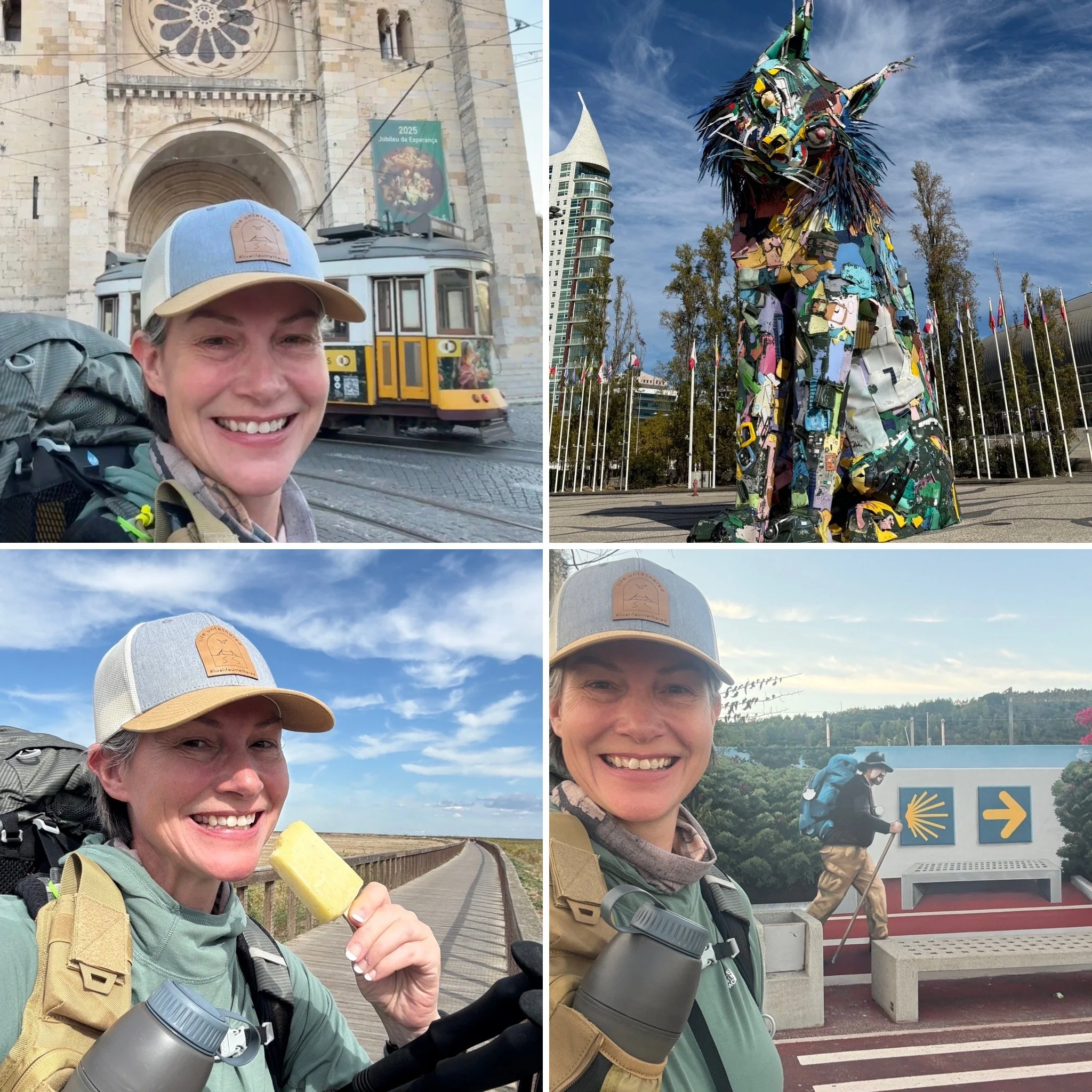
I started in Lisbon with a 38-litre pack, a set of hiking boots that were already hurting my feet, and absolutely no idea what Day 1 would feel like. Thirty-eight kilometres later, I was lying in a bath in Vila Franca de Xira drinking a little carton of red wine, doing my laundry in the bathtub, and feeling more alive than I had in years.
That was Day 1. I walked all the way to Finisterre. 800km. 31 days.
I have spent a lot of time since then talking to women who are planning their first Camino — women who are excited, overwhelmed, second-guessing their route, and wondering if they can actually do this alone. This post is for all of them. It is everything I wish someone had told me before I left.
The Camino Portuguese is one of the best walking routes in the world for a first-time solo woman pilgrim. Here is why — and what you actually need to know before you go.
Is the Camino Portuguese a Good Route for Solo Women?
Yes. Without question, yes.
In 2025, over 190,000 people walked the Camino Portuguese. Most of the solo walkers I encountered were women. The route from Porto to Santiago is well established, well marked, and well serviced. You are rarely walking alone in the sense of being isolated — there are cafés, villages, other pilgrims, and locals who will redirect you when you miss a turn (and you will miss a turn).
Personal safety was something I thought about before I left. It stopped worrying me about two hours into my first day. I never felt unsafe. Not once.
What I did feel was free. Completely, gloriously free.
But wait — I started in Lisbon, not Porto
Most people start in Porto because it makes for a clean two-week walk to Santiago. The statistics office only tracks Porto and it is the most established starting point. I started in Lisbon because I’m a glutton for punishment, I wanted the full experience — and because a bottle of red wine in a bath had given me the idea and I was committing fully.
If you start in Lisbon, know this: the first few days are significantly less established than the section from Porto north. There are no albergues for the first couple of days, the route is less clearly marked, and you are genuinely on your own figuring some of it out. I spent Day 1 walking 39 kilometres in 30-degree heat with no shade and a backpack that was too heavy. I do not recommend repeating my exact approach. I do recommend knowing what you are getting into, and you can read more about preparing for your Camino here.
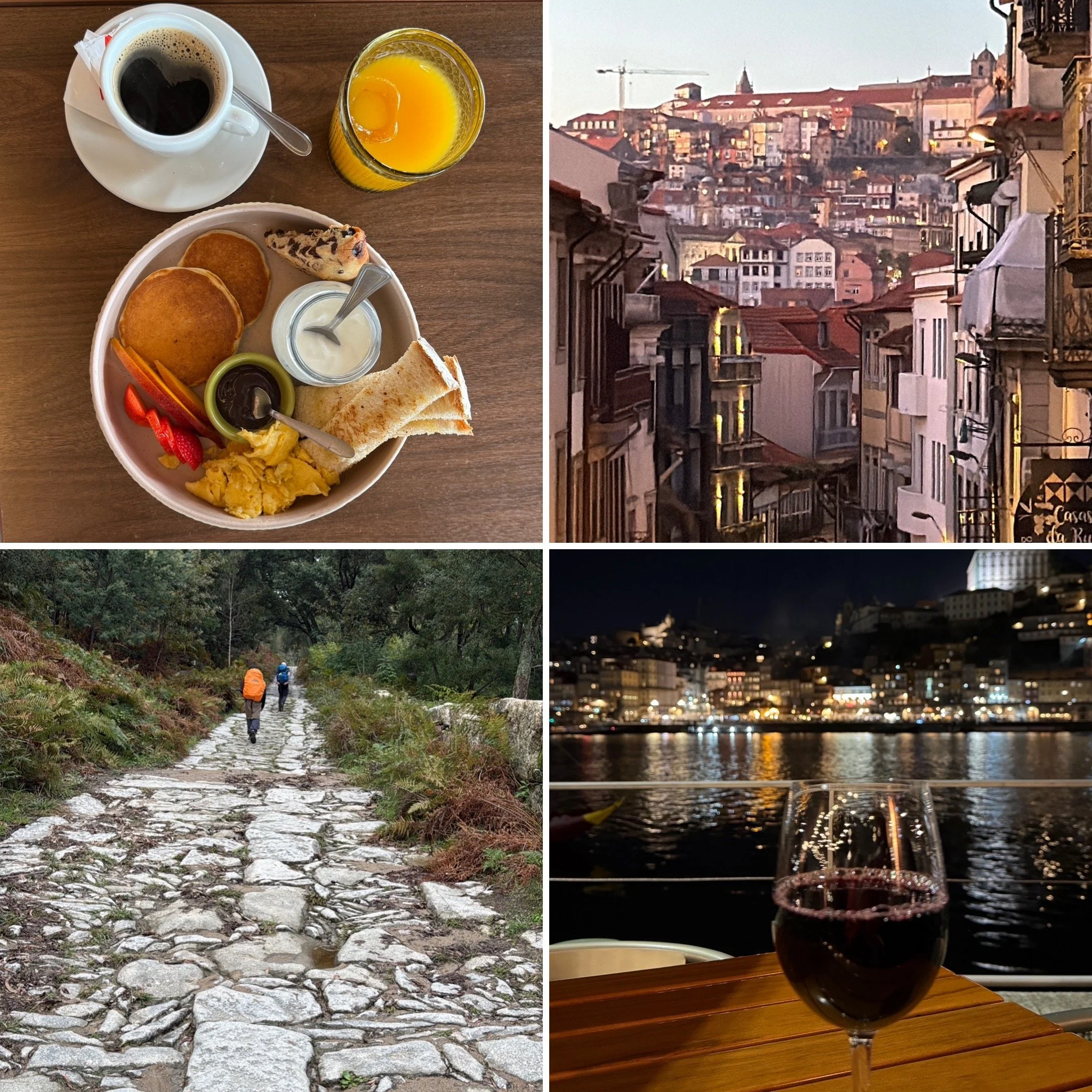
If it is your first Camino, starting in Porto is the sensible choice. The section from Porto to Santiago takes around two weeks and gives you everything — history, coastal stretches, vineyards, cities, villages, and fellow pilgrims.
The Four Routes: Which One Is Right for You?
One of the most common questions I get from women planning their first Camino is which route to take. Here is the honest answer: you do not have to decide before you go. The Camino Portuguese has four routes and you can switch between them as you walk.
The Central Route
The main route. Most people walk this one. You head north from Porto through towns, cities, and vineyards. There is more elevation change than the other routes — more up and down. It is beautiful. There are lots of other pilgrims.
The Coastal Route
Despite its name, this route does not actually hug the coastline. You are near the coast, walking through towns and villages, but a fair amount of it is on pavement. I walked sections of this and it is lovely, just not quite the dramatic Atlantic experience the name suggests.
The Littoral Route
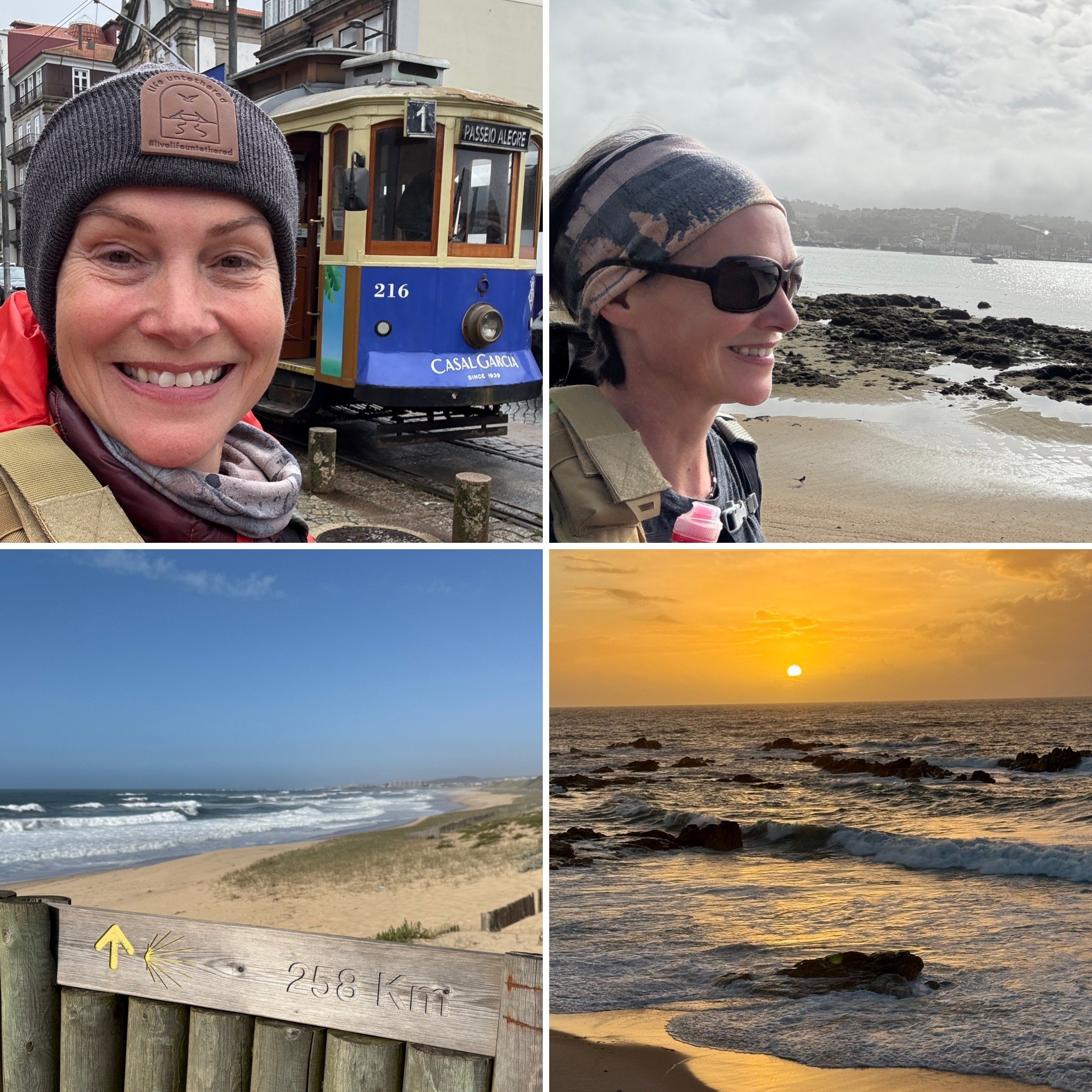
This is the actual coastal route. Boardwalks. Beaches. The Atlantic right beside you. Depending on the weather this is either magnificent or relentlessly exposed. I walked a long section of this heading north from Porto and it was one of my favourite sections of the entire trip — right along the ocean, mostly on boardwalks, in beautiful weather.
The Spiritual Variant
A quieter, more reflective detour north of Pontevedra, including a boat trip. It is significantly less busy than the main routes. In 2025, fewer than 2,500 people walked it. I found this section hauntingly beautiful.
My suggestion: start on the Littoral and switch to the Central or Coastal route when it suits you. Cross over at Redondela if you want to catch the Spiritual Variant, and at Valenca/Tui for the Central. The Camino Portuguese is designed for this kind of mixing and matching — that flexibility is one of its great strengths.
What Nobody Tells You About Packing
I overpacked. Significantly. I started with a 38-litre pack, sent a box of stuff home from a post office on Day 2, sent another box from Santarém, and still felt like someone kept adding rocks to my bag in the night.
The rule of thumb is that your pack should be no more than 10% of your body weight. Get it under that if you can. The smaller and lighter your pack, the more you will enjoy your Camino. This is the single most important practical piece of advice I can give you.
Here are a few things I was genuinely glad I packed:
A long phone charger cable — power outlets are not always near your bed
Earplugs and an eye mask — non-negotiable for albergue sleeping
A small foldable grocery bag — I used it as an evening bag, a carry-on, and for taking laundry to the shower
Clothes pegs — for hanging laundry and creating a privacy curtain in your bunk
Things I did not need: a day bag, a second pair of trainers, a tripod for my phone, extra water bottles, half the clothes I packed.
Do not buy your boots and pack on Amazon and hope for the best. Go to a proper outdoor store, get fitted, and walk in them for weeks before your Camino. The boots that feel fine for an hour will not feel fine on Day 3 after 30 kilometres on pavement. I bought new trail runners from a Decathlon in Santarém at the end of Day 3. Worth every euro.
The Reality of Daily Life on the Camino
People ask me what a typical day on the Camino looks like. Here is mine, more or less.
I was up at 6:30, out the door by 7. I loved walking before sunrise — the birds, the light changing, the cool air. I would eat my breakfast as I walked and find a café around 10 for coffee and a pastel de nata. After a few more hours I would stop for lunch, then walk until mid-afternoon, arriving at my accommodation somewhere between 2 and 5pm.
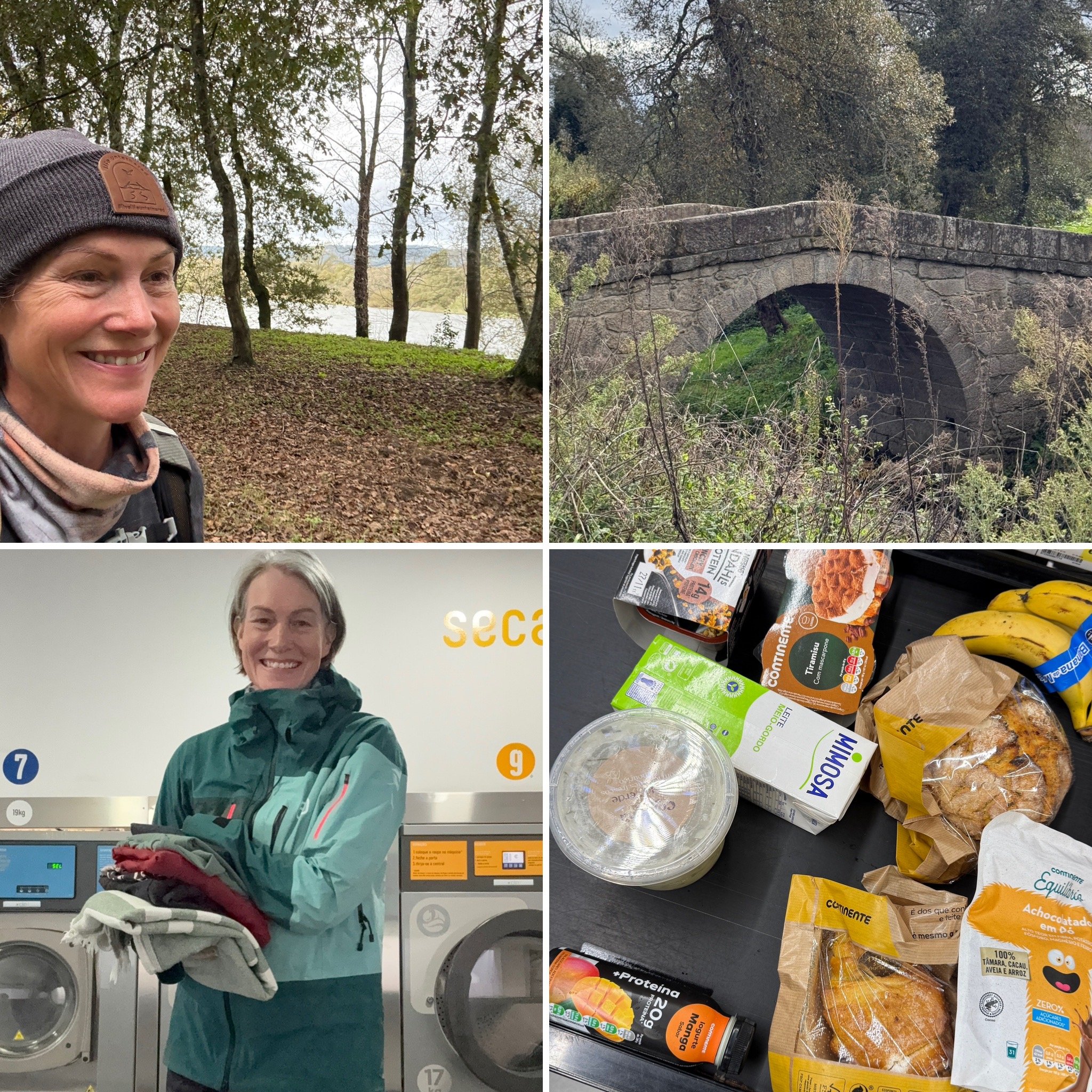
First thing: shower and hand-wash your kit. Then explore, eat dinner, be in bed by 8. Get up and repeat.
The rhythm is the thing. There is something profoundly settling about a day with such a clear structure. Within about a week I stopped thinking about home entirely and simply existed in the Camino.
How far should I walk each day?
You will not know until you get there. I trained seriously, thought I knew what I would do, and then changed everything once I was on the ground. My shortest day was 2.5 kilometres. My longest was 41. I averaged around 25 to 28 kilometres.
Build in flexibility. Rest days are not failure — they are part of the Camino. One of my favourite days was a rest day in Santarém where I explored the city, had a long lunch, bought new shoes, and stopped trying to make everything fit a plan.
What about the bathrooms?
I am going to say what the guidebooks do not: you will pee outside. Multiple times. This is normal, expected, and fine. Keep a small kit in your pack — hand sanitiser, wet wipes, a little tissue, a plastic bag. Practice squatting at home before you go. You will thank yourself.
Portugal is actually excellent for public facilities compared to what I expected. Parks in towns often have clean bathrooms. Cafés are generally happy for you to use theirs after buying a coffee. And sometimes there is literally nowhere to go and you just go.
The Camino provides. Sometimes what it provides is a convenient olive grove.
Staying Safe as a Solo Woman
Is it safe to walk the Camino Portuguese as a solo woman? This is the question I get most often and the answer is straightforward: the Camino de Santiago is statistically very safe. Safer than most North American cities.
I never felt unsafe. Not walking before dawn. Not staying in mixed dorm rooms. Not walking sections alone.
That said, here is how I approached it:
If a section felt uncomfortable I walked with other pilgrims.
I paid attention to my surroundings, especially in cities.
I trusted my instincts. When something felt fine, it was fine. When it did not, I changed the plan.
One thing I had not planned for was flooding. Several sections of the trail flooded while I was walking. I watched where other pilgrims walked before committing to a path, and I did not hesitate to take an alternate route when it made sense. The police actually closed one section I had walked earlier in the day.
You are not alone out there, even when you are walking alone.
People will redirect you if you go off trail. Locals will honk their horns and point you back in the right direction. Random women will offer you tea from their car window. The kindness of strangers on the Camino is one of its defining features.
Money: What Does the Camino Portuguese Actually Cost?
I budgeted 50 euros a day. I averaged 63. If you want to be comfortable — decent accommodation, sit-down meals, the occasional glass of wine — budget 75 euros a day and you will feel relaxed about it.
Some context for that:
A coffee is about 1 euro in Portugal, slightly more in Spain
A pastel de nata is about 1 euro
A pilgrim menu (soup, main, drink, dessert) is 10 to 15 euros
Municipal albergues are 5 to 15 euros a night
Private albergues and hostels are roughly 20 to 30 euros
Private rooms and hotels vary from 40 euros to considerably more
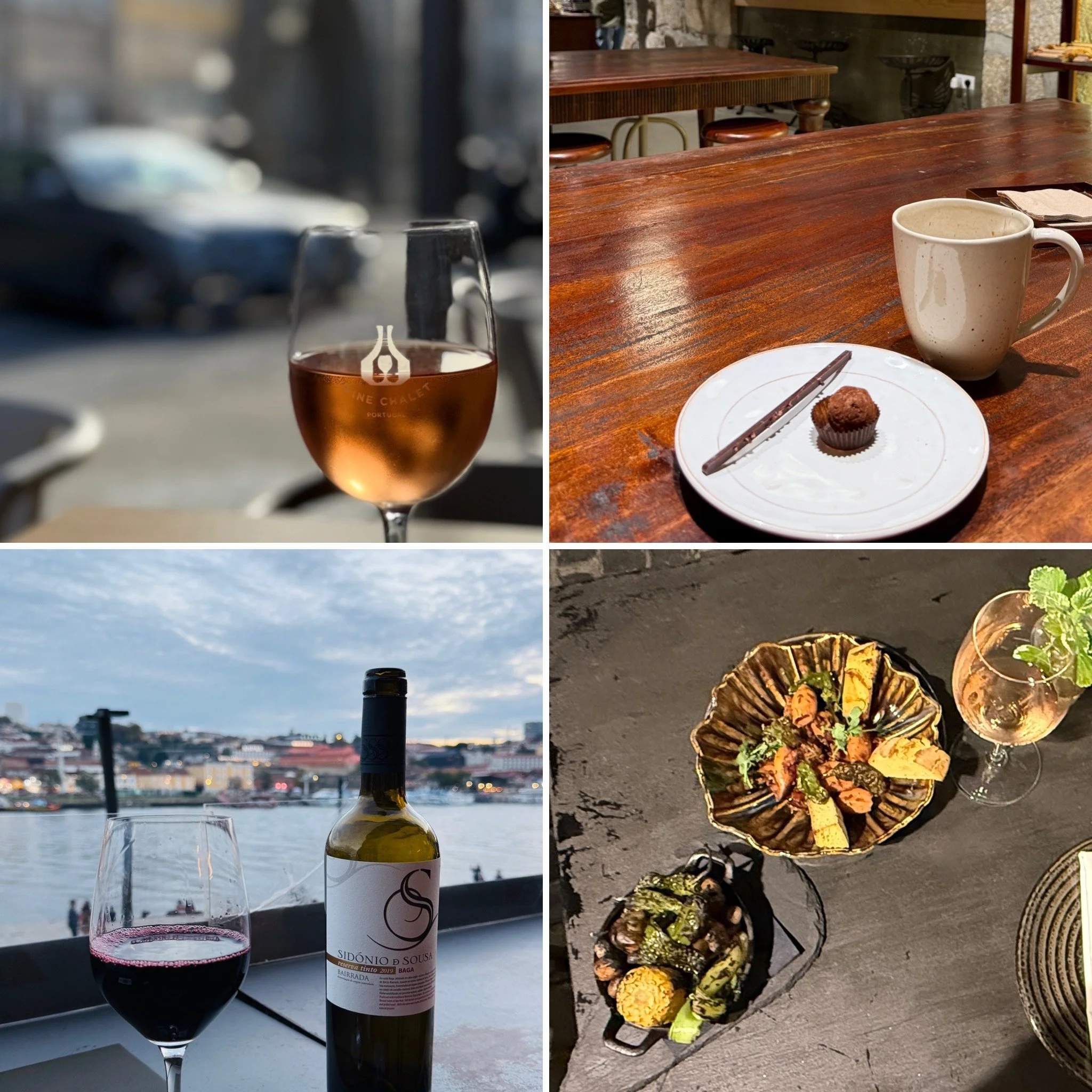
I mixed it up throughout. Some nights in dorm rooms, some in private rooms when my body needed space and quiet. A few nights in genuinely nice hotels — including a four-poster suite in the Douro Valley that was entirely his idea and entirely wonderful.
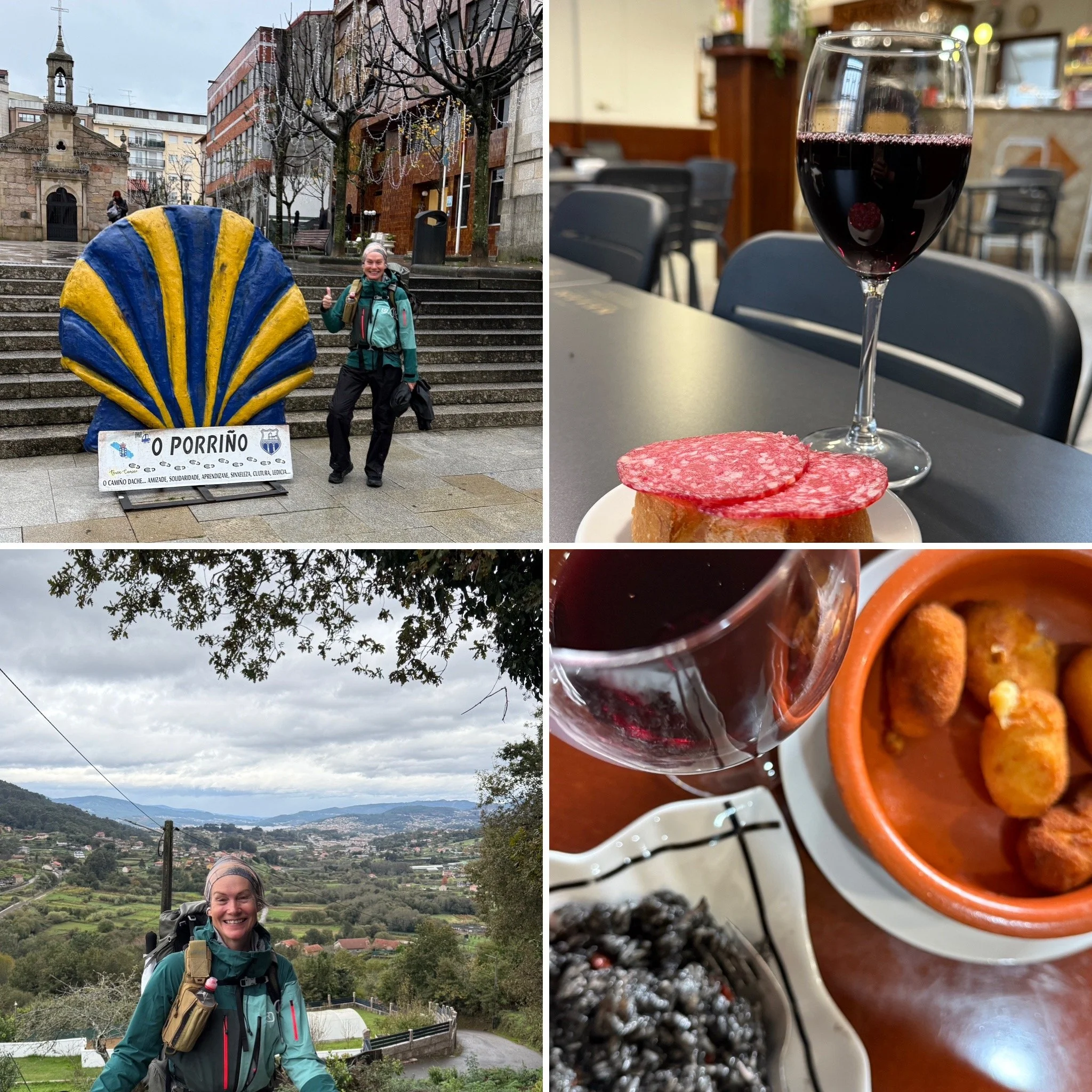
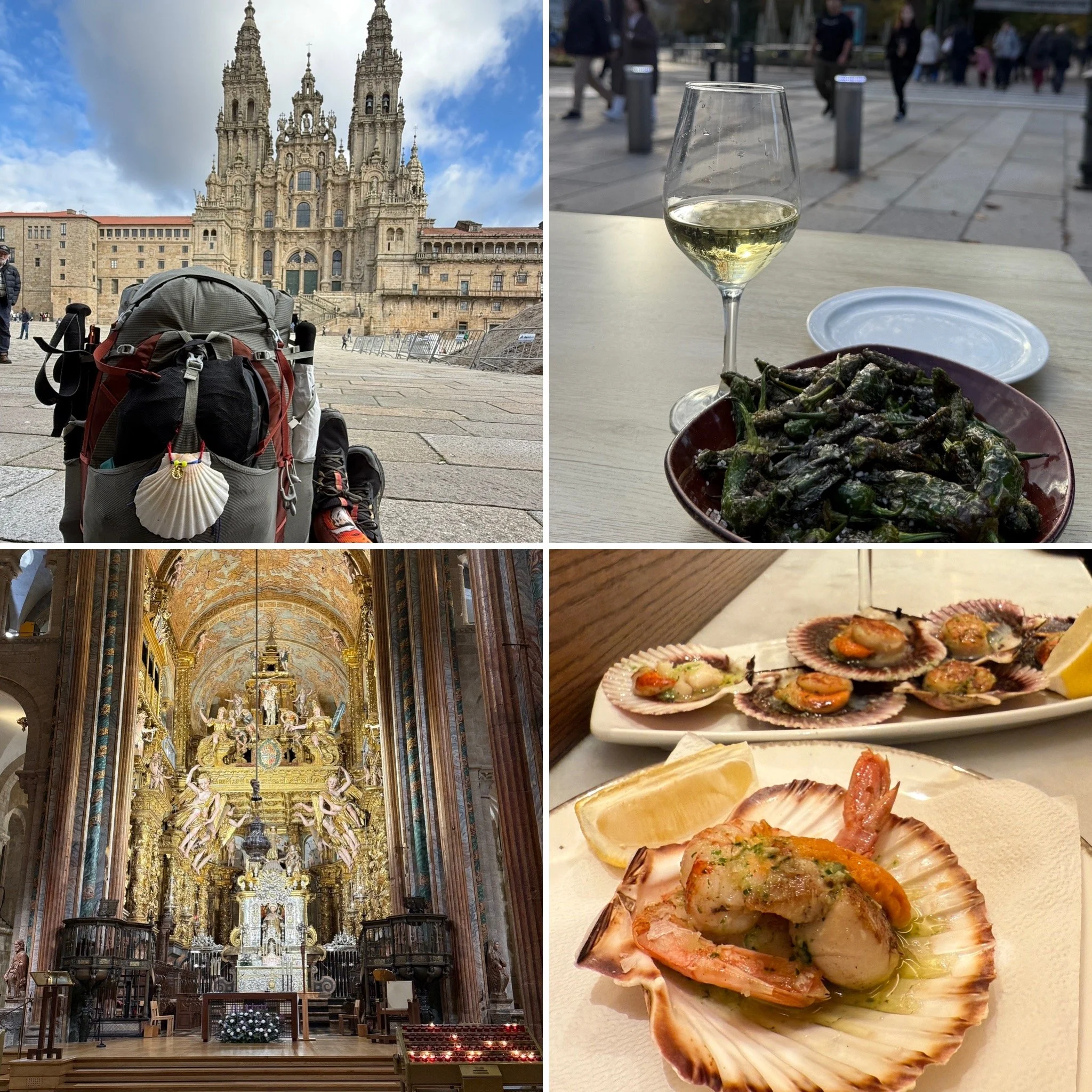
Spain is slightly more expensive than Portugal. The wine is different (and excellent). The food shifts noticeably when you cross the border — hello, pimientos de Padrón and Galician octopus.
The Moment I Nearly Quit — and What Happened Instead
Day 39. I was in a pension in a small village south of Cee. I had already walked 36 kilometres that day. I was tired. The restaurants were closed. I could hear my neighbour coughing through the wall.
I set two alarms. One for 6am — if I was going to try to walk to Cee. One for 7:45 — if I was going to take the bus.
My coughing neighbour woke me before either alarm. I looked outside. It had rained, but it had stopped. The forecast showed only a little rain around 1pm. My body felt better after sleeping - as it did every day.
I put on my boots.
I walked 41 kilometres that day. A marathon. I arrived at my apartment in Cee at 5pm after 10 hours of walking. And the next morning I walked to the lighthouse at the end of the world.
I just kept trusting and believing and going. Not looking at how long I had been walking or how many kilometres I had done. And I did it.
The Camino teaches you something very specific about yourself: that you are capable of more than you think. Not because someone told you. Because you did it.
A Few Things That Surprised Me
Flamingos. There are flamingos in the estuary south of Lisbon. I had no idea.
The Roman ruins at Conímbriga are extraordinary — mosaics, walls, an entire city that you can walk through and touch. Do not skip this.
The customer service culture is completely different from North America. Someone will finish their conversation before they take your payment. Embrace the pause. You are not in a hurry.
People walk the Camino in all directions. I met a Dutch man who had walked from Lisbon to Santiago, then to Finisterre, and was now walking back to Fatima and then on to Lisbon. I met two Spanish men walking from Barcelona to Santiago and then south to Faro — 1,280 kilometres, Day 47.
The physical and emotional experience will not stay separate. There will be days when your body hurts and your mind goes quiet. There will be days when something shifts and you cannot explain why. Let it happen.
Ready to Start Planning?
If you are planning your first Camino Portuguese solo and you want practical, honest guidance from someone who has walked it — I built a course specifically for you.
Camino Confidence is a self-paced course of 10 modules and 30 short videos covering everything from choosing your route and packing your bag to navigating solo, managing daily life, and making the most of the experience.
It is everything I wish I had had known before I left.
→ Learn more about Camino Confidence here
Or if you want to talk through your specific questions — your route, your timing, your concerns — I offer a 90-minute Ask Me Anything coaching session where we go through everything together.
→ Book your 90-minute Camino AMA session here
Bom Caminho.
— Emma